




Eric Reed Calls for “One Standard of Justice” in Debate Over Flock Cameras
Dallas County DA candidate supports law enforcement technology with safeguards for privacy, oversight and compliance with Texas law
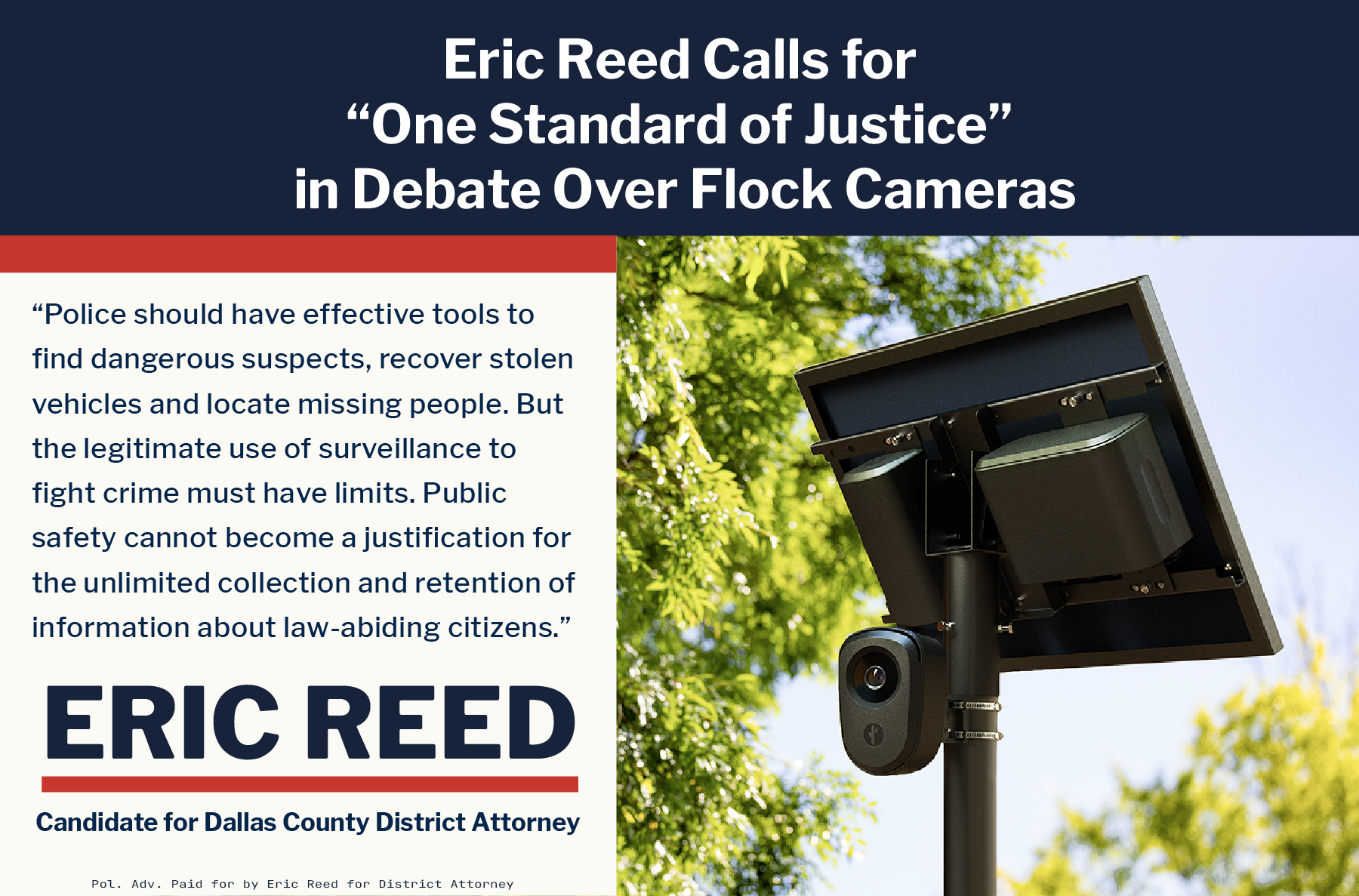
DALLAS, TEXAS — Dallas County District Attorney candidate Eric Reed today called for a balanced approach to the growing controversy surrounding Flock Safety cameras, as Dallas prepares to cancel hundreds of the automated license plate readers following Gov. Greg Abbott’s decision to block additional state spending on the technology.
The Dallas Police Department will cancel 321 Flock cameras funded through affected state grants effective September 15, while more than 300 cameras are expected to remain in operation. The move comes amid a broader debate over the cameras across Texas, even as the Texas Department of Public Safety continues to operate its own extensive Flock network.
“This debate has been framed as though we have to choose between public safety and individual privacy, but it’s not a binary choice,” Reed said. “Police should have effective tools to find dangerous suspects, recover stolen vehicles and locate missing people. But the legitimate use of surveillance to fight crime must have limits. Public safety cannot become a justification for the unlimited collection and retention of information about law-abiding citizens.”
Flock cameras are automated license plate readers (ALPRs) that capture and organize information about vehicles traveling on public roads. While the technology can provide investigators with important leads, its expanding capabilities have raised concerns about privacy, data sharing, retention and potential misuse.
Reed said clear rules should govern when the technology may be used, who may access the information, how searches are documented and how long data is retained.
“There should be a legitimate law enforcement purpose behind every search and an audit trail showing who accessed the system and why,” Reed said. “When someone abuses that access, there should be consequences. Citizens should also know who is responsible for these cameras, with clear labeling that identifies who owns and operates them, who maintains them, and provides contact information so the public knows exactly who is accountable.”
That responsibility includes complying with the laws and regulations governing companies that provide technology and information used in criminal investigations.
Texas regulators previously issued Flock Safety a cease-and-desist order after determining that the company had operated without a required private-investigator license. The company later experienced an additional licensing suspension related to proof of required liability insurance.
“For me, this comes back to One Standard of Justice,” Reed said. “If a private company wants to do business with law enforcement and provide information that can become part of a criminal investigation or prosecution, that company has an obligation to follow Texas law. The rules cannot apply to the person being investigated but somehow become optional for the company helping conduct the investigation.”
Moreover, Reed said, companies doing business in Texas must comply with state registration requirements, including maintaining a registered agent on file with the Texas Secretary of State, and remain subject to applicable Texas laws and regulations.
Reed said he does not support eliminating automated license plate readers simply because the technology can be misused, nor does he support deploying them without meaningful oversight.
“The answer isn’t to take useful investigative tools away from law enforcement,” Reed said. “It’s to establish clear limits, transparency, accountability and respect for constitutional rights.”
As technology and artificial intelligence play an increasing role in criminal investigations, Reed said prosecutors also have a responsibility to understand how evidence is obtained and whether the companies and agencies producing it have complied with the law.
“A prosecutor’s responsibility isn’t simply to obtain convictions. It’s to make sure justice is done and that evidence used in our courts was obtained lawfully and can withstand scrutiny,” Reed said. “One Standard of Justice means one standard for the accused, one standard for law enforcement and one standard for the companies we entrust with public safety. Nobody gets an exemption from the law.”
About Eric Reed for District Attorney:
Eric Reed is a Dallas trial attorney and former prosecutor with more than three decades of experience in criminal law, federal and tribal courts, and complex litigation. He is running as a write-in candidate for Dallas County District Attorney on a commitment to Public Safety • Fairness • Accountability.
To vote for Eric Reed, select the write-in option in the Dallas County District Attorney race and enter the name Eric Reed.
For more information, visit www.WriteinReed.com.
Media Contact:
media@writeinreed.com